Common Surfing Camps Packing Mistakes: Ultimate Surf Trip Guide
Common Surfing Camp Packing Mistakes. The evolution of surf travel from rugged, exploratory expeditions to structured surf camps has fundamentally shifted how surfers prepare for time spent on foreign coastlines. Historically, traveling with a surfboard meant anticipating isolation, packing multiple blocks of wax, extra resin, and relying on rudimentary equipment. Today, the global proliferation of surf camps offers a baseline of hospitality, professional guiding, and localized infrastructure. This modern convenience, however, frequently creates a false sense of security regarding preparation. Travelers often assume that commercialized surf destinations eliminate the logistical friction traditionally associated with coastal wilderness exploration.
This assumption introduces distinct vulnerabilities into the packing process. When travelers rely on the perceived safety net of a managed camp, they frequently misjudge the specific environmental, physical, and technical demands of the destination. A surf camp environment blends high-intensity physical exertion with communal living, often in remote geographic zones where specialized retail is non-existent. Consequently, packing errors are rarely resolved by a quick trip to a local store. Simple omissions or overpacking can quickly degrade physical performance, cause avoidable injuries, or result in systemic logistical friction throughout the journey.
A successful surf camp stay requires a precise equilibrium between equipment redundancy and mobility. The parameters of this equilibrium shift constantly based on seasonal swells, regional microclimates, and the specific architecture of the chosen camp. Understanding the nuances of coastal packing requires a departure from generic travel habits. It demands an analytical approach that treats gear as a functional system designed to support prolonged periods of physical vulnerability in highly dynamic marine environments.
Understanding “common surfing camps packing mistakes”
The analytical exploration of common surfing camps packing mistakes reveals a significant disconnect between standard vacation preparation and specialized sports travel. Most travelers approach surf camp preparation through a binary lens, categorization happening simply between clothing and surfing equipment. This oversimplification fails to account for the fluid nature of coastal environments, where gear serves as an active barrier against environmental degradation. The phrase common surfing camps packing mistakes does not merely refer to forgotten items. It encompasses a systemic failure to anticipate the intersection of physical fatigue, climate variance, and equipment limitations.
A primary misunderstanding is the reliance on convenience bias. Travelers frequently assume that modern surf camps operate like urban resorts, expecting on-site retail environments to stock custom medical supplies, specific fin templates, or precise neoprene thicknesses. In reality, surf camps are often located at the geographical termini of developing infrastructure. When specialized gear fails or is omitted, replacing it locally can consume days of valuable swell windows or require high financial premiums for substandard equipment.
Furthermore, packing errors often stem from a fundamental miscalculation of tropical climates. The assumption that warm water equates to a low-gear requirement leads many to omit thermal protection entirely. Prolonged exposure to wind, early morning dampness, and intense ultraviolet radiation can induce mild hypothermia or severe skin damage, even in equatorial regions. Therefore, analyzing common surfing camps packing mistakes requires looking beyond the checklist to examine how gear functions as a cohesive survival and performance system.
Deep Contextual Background of Surf Travel Logistics
The systemic nature of modern packing errors is deeply tied to the historical trajectory of surf exploration. During the mid-twentieth century, surf travel was defined by extreme self-reliance. Pioneers charting waves in regions like Western Australia, Peru, or the South Pacific traveled with extensive toolkits, raw materials for board repair, and comprehensive medical provisions. Because there was no hospitality infrastructure, packing was approached with the same gravity as an alpine expedition.
The commercialization of surf travel in the late 1980s and 1990s introduced the structured surf camp model, transforming remote outposts into accessible destinations. As operations standardized accommodation, dining, and boat logistics, the perceived barrier to entry dropped significantly. This shift altered the psychological preparation of travelers. The survivalist mindset of early surf travel was replaced by a consumer mindset, leading to a gradual degradation of packing discipline.
In the current era, the widespread availability of high-performance, specialized surf equipment has complicated rather than simplified the packing process. Modern surfers must navigate complex technical choices across a wide range of gear variations. These options include:
-
Diverse surfboard construction methods (PU vs. EPS epoxy),
-
Varied fin setups (Futures vs. FCS II, thruster vs. quad),
-
Highly specific neoprene weights, and
-
Specialized skin-protection fabrics.
When these technical choices are combined with the rigid baggage constraints of modern aviation, the margin for error narrows considerably. The contemporary surf traveler must fit a highly technical, multi-environmental toolkit into strict weight limits. Consequently, modern packing errors are rarely caused by simple laziness. Instead, they are typically driven by a failure to manage the complex technical requirements of modern surf gear within the strict constraints of global travel logistics.
Conceptual Frameworks and Packing Mental Models
To mitigate the systemic errors that compromise surf travel, packing can be managed through structured mental models. These frameworks transform packing from a subjective exercise into a rigorous, objective workflow.
The Environmental Exposure Model
This framework categorizes every packed item by its capacity to mitigate specific environmental forces: Ultraviolet Radiation, Thermal Energy Transfer, and Mechanical Abrasion.
Items should not be chosen based on aesthetic appeal or casual comfort. Instead, they must be selected for their functional resilience against these three distinct vectors. For example, a rash guard is not just clothing; it serves as a critical shield against mechanical friction from the surfboard deck and an active barrier against UV rays. Every piece of apparel must be evaluated by its ability to protect the body during extended exposure.
The First-Order vs. Second-Order Dependency Model
This model organizes gear based on how critical it is for basic functionality. First-order items are components that cause total system failure if lost or broken. Second-order items are accessories that enhance comfort or performance but can be bypassed in an emergency.
-
First-Order Components: Surfboards, fins, fin screws, leashes, and specialized reef protection. If a fin screw is lost in a remote region, the entire surfboard system becomes unusable.
-
Second-Order Components: Board bags, wax combs, surf watches, and changing robes.
By categorizing items this way, travelers can prioritize space and budget for critical redundancies, ensuring that backup fin keys, extra leash strings, and spare hardware are packed before non-essential comforts.
The Thermal Equilibrium Range
This framework challenges the assumption that warm-water destinations require zero thermal protection. While sea surface temperatures in tropical zones may feel comfortable initially, prolonged immersion combined with wind exposure can quickly drain core body heat.
The model requires packing a versatile range of thermal layers, such as 1mm neoprene vests or high-density lycra. These items help regulate core body temperature during long morning sessions, cloudy afternoons, or unexpected weather shifts.
Key Categories of Gear and Technical Trade-offs
A successful surf camp strategy requires navigating complex material and design trade-offs across several gear categories.
Surfboard Construction Dynamics
The choice between traditional Polyurethane (PU) and Expanded Polystyrene (EPS) Epoxy construction involves clear trade-offs between durability and performance during travel. PU boards offer a familiar, damp feel that cuts through choppy water smoothly, but they are highly susceptible to pressure dings and structural cracking during air transit.
Conversely, EPS Epoxy boards are lighter and more resistant to impact, making them highly resilient against careless airport handling. However, they can feel overly buoyant and chattery in windy, rough surf conditions. Additionally, if the outer skin of an epoxy board is punctured, the core absorbs water rapidly, requiring immediate and complex repairs.
Fin System Configurations
Selecting a fin ecosystem requires choosing between dual-tab (FCS II) and single-tab (Futures) pre-installed box structures. The FCS II system offers the convenience of tool-free installation and removal, making it easy to pack boards quickly. However, the complex mechanism can become jammed by fine sand or coral dust, and a hard impact can wrench the fin out, potentially damaging the fiberglass box.
The Futures system uses a single, angled screw that runs along the base of the fin, providing a highly secure mechanical connection that distributes stress evenly across the board’s core. The trade-off is the absolute requirement of a physical tool for any adjustment; losing the fin key renders the entire system non-functional.
Apparel Composition Maturation
The composition of surf apparel directly impacts skin health and physical comfort during multi-day trips. High-percentage elastane blends provide excellent stretch and freedom of movement, minimizing paddle restriction around the shoulders. However, these fine fibers degrade quickly when exposed to intense UV radiation and constant saltwater immersion, leading to shape loss and reduced skin protection.
On the other hand, heavy polyester or tightly woven nylon fabrics offer superior durability and excellent resistance to abrasion from the surfboard’s wax. The trade-off here is increased friction against the skin, which can cause painful rashes during long sessions if the garments are not cut precisely.
Detailed Real-World Scenarios and Failure Modes
Scenario 1: The Remote Tropical Atoll Swell Variance
A traveler arrives at a remote surf camp in the outer islands of Indonesia or Fiji with a single “all-rounder” surfboard, assuming the waves will remain uniform throughout the week. Two days into the trip, a deep low-pressure system generates a massive, long-period groundswell, doubling the wave size and drastically increasing water volume moving over the reef.
-
Constraint: The traveler has no access to alternative board sizes or heavy-wave equipment.
-
Decision Point: The surfer must either attempt to paddle out on a board that lacks the paddle power to catch fast-moving waves safely, or remain on land, missing a rare swell window.
-
Failure Mode: Attempting to surf under-gunned leads to late drops, severe wipeouts, and a broken surfboard, which eliminates all remaining surf opportunities for the trip.
-
Second-Order Effects: The broken board releases non-biodegradable foam and fiberglass into a fragile marine ecosystem, while the traveler faces expensive shipping fees to import a replacement board or must rent ill-fitting gear from the camp’s limited inventory.
Scenario 2: High-Latitude Thermal Isolation Failure
A surfer travels to a cold-water surf camp in Norway or Tofino during early spring, bringing a well-worn 4/3mm wetsuit with standard flatlock stitching, assuming the camp’s drying facilities will compensate for any gear limitations.
-
Constraint: Ambient night temperatures stay near freezing, and the camp’s communal drying room is humid and overloaded with gear.
-
Decision Point: The traveler must choose between putting on a damp, freezing wetsuit for a dawn session or waiting until afternoon, missing the cleanest wind conditions.
-
Failure Mode: The damp suit allows cold water to flush through the seams continuously, causing rapid core heat loss, early shivering, and cognitive fatigue that impairs physical timing.
-
Second-Order Effects: Extended exposure to damp, freezing neoprene causes severe skin chafing and raises the risk of mild hypothermia. This physical toll forces the surfer to take multiple rest days, missing the best surf windows of the trip.
Scenario 3: The Reef Cut Invalidation Pipeline
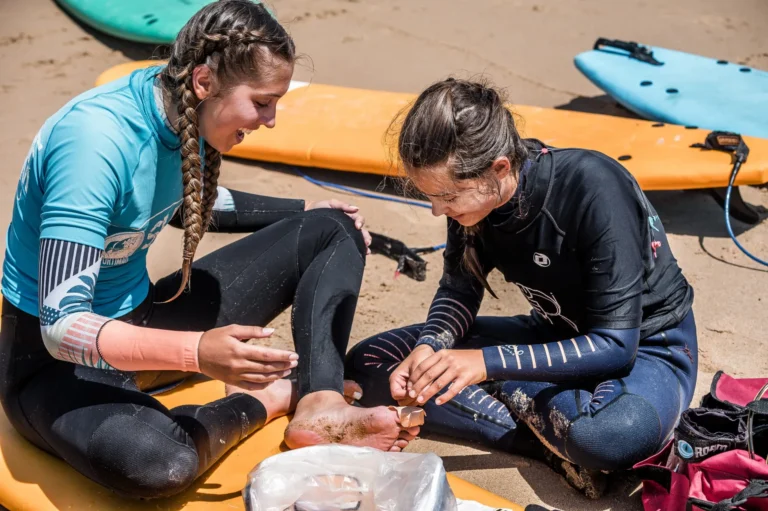
During a low-tide session at a volcanic reef camp, a surfer suffers a seemingly minor scrape on the instep of their foot from live coral. The traveler did not pack a comprehensive medical kit, relying instead on the camp’s basic first-aid box, which contains only standard adhesive bandages and low-grade antiseptic wipes.
-
Constraint: The camp is located several hours away from a medical clinic, and humid tropical air slows natural wound healing.
-
Decision Point: The surfer must decide whether to stop surfing to keep the wound dry or cover it with a standard bandage and continue paddling out into warm, bacteria-dense water.
-
Failure Mode: The standard bandage detaches within minutes of exposure to saltwater, leaving the open wound vulnerable to aggressive marine bacteria.
-
Second-Order Effects: The scrape quickly develops into a severe infection, causing painful swelling and requiring a course of systemic antibiotics. The surfer is forced to stay out of the water entirely, ruining the remainder of the trip.
Planning, Cost, and Resource Dynamics
The financial planning for a surf camp expedition extends well beyond the base cost of accommodation and guiding services. Airline baggage policies represent a volatile, complex cost variable that can significantly impact the overall trip budget.
Many regional airlines serving remote coastal zones enforce strict weight limits that are much lower than international standard allowances. Exceeding these limits can result in steep, per-kilogram overage fees that quickly surpass the value of the gear being transported.
Furthermore, overpacking introduces hidden indirect costs. Transporting excessively heavy, bulky board bags limits ground transportation options, often forcing travelers to pay for private vans rather than using affordable public transit or shared shuttles.
Conversely, underpacking creates an expensive dependency on the surf camp’s internal rental market. In remote regions, renting a backup board, buying replacement fins, or purchasing high-zinc sun protection can carry a 200% to 300% markup over retail prices. This financial premium reflects the high cost of local importing, turning preventable packing omissions into significant financial liabilities.
Strategies, Systems, and Packing Protocols
To ensure consistent preparation and eliminate reliance on memory, travelers can implement structured packing strategies and systems.
The Modular Cube System
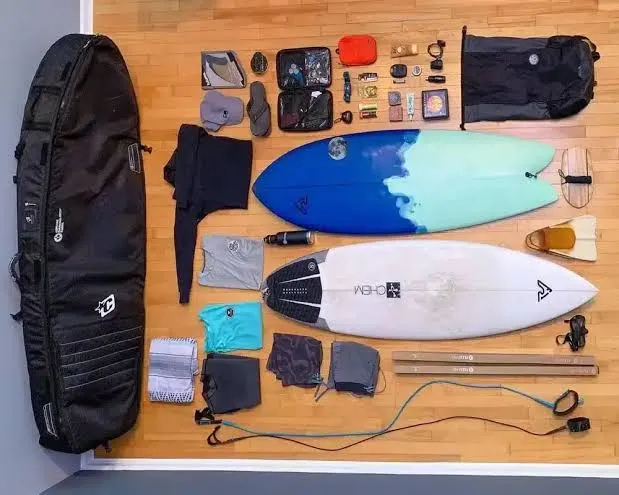
Organize all gear into functional, self-contained internal modules. Rather than packing items loosely into a large duffel, use color-coded, water-resistant compression cubes to group gear by function. One module holds fin arrays, keys, and hardware; another contains first-aid and dermatological defense; a third holds technical surf apparel. This system simplifies gear inspection at border checkpoints and ensures that critical items remain organized throughout the trip.
Pre-Flight Board Protection Wrapping
Standard bubble wrap often fails during long international transits. To ensure adequate protection, use heavy-gauge polyethylene foam profiling along the rail paths of the surfboard, where impact damage occurs most frequently.
Secure the nose and tail blocks with custom neoprene caps or high-density cardboard sleeves. Fill the gaps between the boards with soft items like wetsuits or towels, making sure no hard objects touch the fiberglass shells.
Multi-Stage Fin Selection Setup
Do not pack a single fin set and assume it will work across all conditions. Bring at least three distinct templates:
-
A high-rake set for maximum drive and stability in large, long-period waves,
-
A neutral, balanced set for everyday conditions, and
-
A small, stiff template for control in hollow, fast-moving reef breaks.
Always pack matching sets of spare screws and dual-system composite fin keys to protect against stripped hardware.
Comprehensive Tropical Medical Kit
A specialized surf medical kit should look very different from a standard household first-aid box. It must be stocked to treat deep lacerations, tropical skin infections, and severe sun damage.
Digital Infrastructure Replication
Store all critical documentation, including travel insurance policies, medical records, and surfboard dimensions, in a secure, encrypted offline digital format. Physical paper documents can degrade rapidly when exposed to humid coastal air and saltwater. Maintaining accessible digital copies ensures you can verify insurance coverage or file baggage loss claims even without an active internet connection.
Risk Landscape and Compounding Environmental Vulnerabilities
The consequences of packing errors are often amplified by the interconnected nature of remote coastal environments. A single forgotten item can trigger a chain reaction of vulnerabilities that compromises both safety and performance. For example, failing to pack high-zinc sun protection forces a surfer to use standard, low-viscosity cosmetic sunscreen, which washes off quickly in salt water.
This omission leads to severe sunburn, which accelerates dehydration and disrupts sleep, draining the surfer’s stamina. During a long session, the resulting physical fatigue impairs the surfer’s timing, causing them to miss a critical turn and collide with a shallow reef.
This compounding risk model shows that gear items are not separate luxuries; they are essential parts of a unified safety system. A failure in one component exposes the surfer directly to the forces of the marine environment, turning minor packing errors into significant safety hazards.
Governance, Maintenance, and Long-Term Adaptation
Maintaining an effective travel kit requires an ongoing process of review and adjustment. Gear should be systematically inspected both before departure and after returning from every trip.
The post-trip audit is particularly critical: it allows you to clean gear thoroughly with fresh water, note items that were depleted or damaged, and update your packing lists based on real-world experience.
Pre-Trip Gear Verification Checklist
Technical Equipment
-
Inspect all surfboards for subtle hairline cracks along the rail lines and around the fin boxes.
-
Verify that every fin fits securely into its corresponding box without rocking.
-
Check leash cords for minor structural cuts and ensure the swivel joints rotate freely.
-
Pack two extra leash strings and three spare sets of matching fin screws.
Personal & Environmental Protection
-
Confirm that all sunscreens have a validated UPF rating greater than 50.
-
Inspect wetsuit seams for thinning material or unravelling tape lines.
-
Pack specialized reef booties with high-traction, puncture-resistant outsoles.
-
Verify that rash guards and surf leggings are free from thin spots or fabric tears.
Medical & Logistics
-
Replenish all antiseptic solutions, sterile gauze rolls, and medical skin glues.
-
Update your secure offline digital folder with current insurance and medical data.
-
Check airline baggage weight restrictions and size limits for every leg of the flight.
Measurement, Tracking, and Evaluation of Gear Performance
Experienced travelers do not rely on guesswork; they systematically track how their gear performs over time. By evaluating equipment using clear metrics, you can refine your packing strategy and ensure your kit remains highly efficient for future trips.
Common Misconceptions and Oversimplifications
Myth 1: Surf camps always stock an abundance of spare high-quality boards
This assumption can quickly ruin a trip. While most surf camps maintain a basic rental fleet, these boards are often worn out, waterlogged, or limited to high-volume longboards suited for beginners. If an intermediate or advanced surfer breaks their shortboard, finding a high-performance replacement with the correct dimensions is rarely possible in remote areas.
Myth 2: Tropical water eliminates the need for any neoprene layers
This view overlooks how wind and prolonged exposure drain body heat. Even in 84°F water, a strong offshore wind or an early dawn session can induce shivering over a three-hour period. Packing a thin, 1mm neoprene vest or a high-quality wind shirt provides critical insulation that keeps you comfortable and extends your session time.
Myth 3: Standard travel insurance automatically covers all action sports injuries
Standard travel insurance policies frequently exclude injuries sustained during hazardous activities like surfing, especially when riding waves over shallow coral reefs.
Travelers must carefully review their policy details and add specific action-sports riders to ensure coverage for emergency medical evacuations and specialized coastal treatments.
Myth 4: Heavy, thick board bags guarantee complete protection during flight
Thick padding helps absorb impacts, but it does not protect boards from structural twisting or heavy crushing forces when bags are stacked carelessly beneath heavy luggage. True protection requires internal reinforcing rails, rigid nose caps, and proper spacing between the packed boards.
Myth 5: A single type of surfboard wax works across all water temperatures
Using warm-water wax in cold conditions turns the grip slick and unusable, while using cold-water wax in the tropics causes it to melt off the deck immediately. Always pack a variety of temperature-specific wax blocks, along with a high-quality basecoat, to match the exact conditions of your destination.
Myth 6: Modern reef booties completely eliminate the risk of foot injuries
Booties provide a helpful barrier against sharp coral and rock surfaces, but they can still be punctured by heavy pressure or slip on wet moss. They should be treated as a secondary line of defense, never as an excuse to walk carelessly across fragile and sharp marine environments.
Ethical, Practical, and Contextual Considerations
Packing for a surf camp stay also involves broader environmental and social responsibilities. Remote coastal communities often lack modern waste management systems, meaning that broken plastic gear, empty plastic sunscreen bottles, and torn synthetic apparel left behind end up directly in local landfills or the ocean. Travelers should minimize waste by choosing durable, long-lasting gear and bringing empty containers back home for proper recycling.
Additionally, choosing sun protection carefully is vital for ocean health. Standard chemical sunscreens contain compounds like oxybenzone and octinoxate, which disrupt coral reproduction and accelerate bleaching, even in small amounts. Using mineral-based sunscreens made with non-nano zinc oxide or titanium dioxide provides effective skin protection while protecting the delicate coral reefs that create the very waves you came to surf.
Conclusion
Preparing for a surf camp requires moving past basic checklists and treating your gear as a highly functional, integrated system. Every choice—from surfboard construction and fin configurations to medical supplies and skin protection—directly impacts your safety, comfort, and performance in dynamic marine environments. By avoiding the common surfing camps packing mistakes highlighted in this guide, travelers can protect themselves against equipment failures, unexpected weather shifts, and preventable injuries. Ultimately, thorough packing discipline transforms your preparation from a chore into a critical tool for a successful surf trip, ensuring you can focus entirely on the waves when the swell arrives.